The Power of Generative AI in Healthcare
Are healthcare operations lagging behind in Innovation?
Healthcare is a sector that thrives on precision, efficiency, and timely decision-making. Yet, many healthcare operations still struggle with inefficiencies, administrative burdens, and data silos, leading to delayed patient care and increased costs. How can healthcare institutions keep up with an ever-growing patient population and the increasing complexity of medical data?
Over the years, automation in healthcare has witnessed the adoption of groundbreaking technologies, from electronic health records (EHRs) to robotic surgeries. However, the introduction of Generative AI is setting a new benchmark in the industry. AI in healthcare is about automation and revolutionising how providers, payers, and patients interact with the system.
What is Generative AI?
Generative AI refers to artificial intelligence systems capable of generating new content, insights, or responses based on large datasets. Unlike traditional AI models that rely solely on predefined rules, Generative AI in healthcare, can learn dynamically, interpret patterns, and create intelligent solutions in real time.
Market Growth & Key Statistics on Generative AI in Healthcare
The global Generative AI in healthcare market is expected to reach $21.4 billion by 2032, growing at a CAGR of 34.9%.
60% of healthcare executives believe that AI-driven automation can significantly reduce operational costs.
Studies indicate that Generative AI can improve diagnostic accuracy by up to 40%, reducing human errors.
Where AI and Automation Fall Short in Healthcare
AI models traditionally used in healthcare are often rule-based, meaning they follow predefined instructions or algorithms without the ability to adapt or learn dynamically from new, unseen data.
These systems excel at performing specific tasks within well-defined parameters but fall short when faced with ambiguity, complexity, or changing conditions.
Key limitations include:
Struggles with unstructured data (e.g., physician notes, patient conversations).
Limited adaptability to new research, evolving treatments, or emerging diseases.
Inability to generate creative solutions in complex medical scenarios.
How Does Generative AI Bridge the Gap?
Generative AI healthcare solutions fundamentally differ from traditional AI and automation in its ability to generate new, contextually aware responses. While conventional AI may simply apply predefined rules to data, generative AI has a deeper understanding and the ability to generate innovative solutions based on patterns it identifies in large datasets. This makes it more adaptable and able to handle the nuances of healthcare more effectively.
Contextual Understanding
Generative AI understands the context in which it operates. For instance, it can process structured and unstructured data, such as medical records, doctor notes, and patient conversations.
It can interpret complex, nuanced information—like a physician’s verbal instructions to a patient—and generate meaningful insights or documentation from it. This allows for a deeper understanding of patient conditions, enhancing both diagnosis and treatment decisions.
Dynamic Adaptability
Unlike traditional AI, which may struggle with evolving situations or new data, generative AI is more adaptable. It can generate responses based on real-time data, allowing healthcare providers to receive up-to-date insights and predictions.
For instance, if new medical research or patient data becomes available, Generative AI can incorporate that information into its analysis, improving accuracy and outcomes. It can also learn from past cases to continuously refine its predictions, treatment suggestions, and administrative support.
Improved Workflow and Efficiency
Generative AI doesn’t just automate existing tasks; it enhances workflows by optimising complex processes. For example, in medical scribing, generative AI can instantly produce detailed, accurate notes during patient interactions, which would be nearly impossible for a human scribe to do in real time.
Similarly, in claims denial management, generative AI can proactively identify issues and suggest corrective actions, automating steps in the resubmission process. This dynamic, intelligent approach to problem-solving makes healthcare workflows more efficient and reduces the burden on staff.
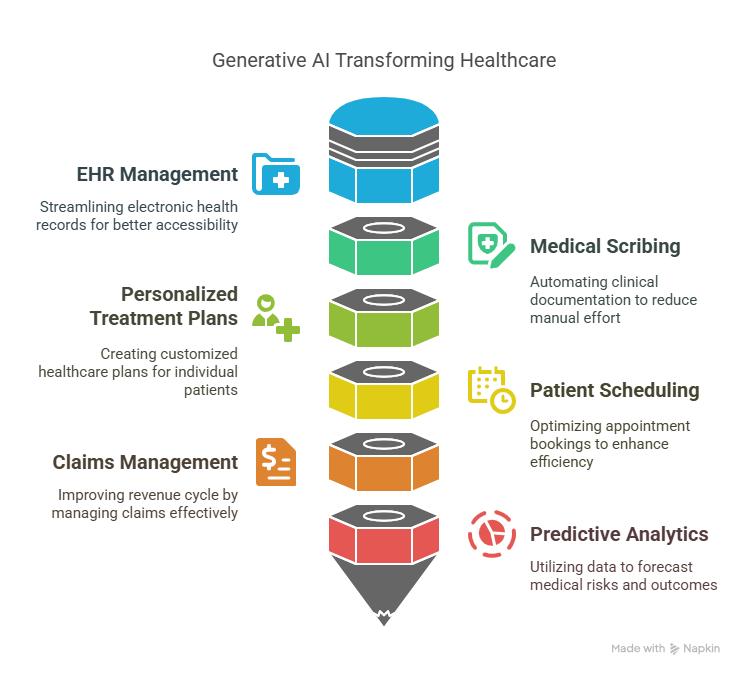
Generative AI Use Cases in Healthcare
Generative AI is transforming various aspects of healthcare operations, addressing inefficiencies where traditional AI and automation fall short.
1. EHR Management and Medical Documentation
Electronic health records (EHRs) are crucial in healthcare, containing patient data such as medical history and treatments. However, managing vast amounts of data can be challenging and time-consuming.
Generative AI simplifies this by extracting and summarizing key information, making patient records more accessible and actionable. It allows quicker data retrieval, improved organisation, and better decision-making, helping healthcare providers save time and focus on patient care.
2. Medical Scribe & Clinical Documentation
Physicians spend a lot of time on documentation, which contributes to burnout. Generative AI-powered medical scribes can transcribe doctor-patient interactions in real time and automatically generate accurate notes.
This reduces the burden on healthcare professionals, improves workflow, and allows doctors to focus on patient care rather than administrative tasks, enhancing efficiency and reducing burnout.
3. Personalized Patient Experience & Treatment Plans
Generative AI tailors health insights, treatment recommendations, and educational content based on a patient’s medical history and lifestyle. By offering personalized advice and resources, it improves patient engagement, adherence to treatment, and outcomes, as patients are more likely to follow a plan tailored to their unique needs.
4. Patient Scheduling
Generative AI optimize patient scheduling by predicting when patients will likely keep appointments based on factors like past behavior and provider availability.
It reduces scheduling errors, minimizes no-shows, and prevents overbooking, streamlining the process and improving patient experience by reducing waiting times and administrative workloads.
5. Claims Denial Management & Revenue Cycle Automation
Managing insurance claim denials can be financially draining. Generative AI analyses denial patterns identifies issues such as coding errors or missing documentation and suggests corrective actions to increase approval rates. AI can automate resubmissions, reducing workload and speeding up payment cycles, leading to more efficient financial management.
6. Predictive Analytics for Medical Risk Prediction
Generative AI uses predictive analytics to identify patients at risk of chronic diseases like diabetes, heart disease, or cancer by analysing patient records and other data. Early detection allows for timely interventions, improving patient outcomes and reducing long-term healthcare costs by preventing more severe conditions from developing.
Generative AI bridges the gaps left by traditional AI and automation by offering dynamic, context-aware solutions that enhance efficiency, accuracy, and patient care in healthcare organisations.
Conclusion: The Future of Healthcare is AI-Driven
The integration of Generative AI in healthcare automation is not just a trend; it is a necessity. As hospitals, healthcare automation companies, insurance providers, and pharmaceutical companies strive for efficiency, Generative AI in healthcare is poised to become the driving force behind the future of healthcare.
From reducing administrative burdens to enhancing patient outcomes, the power of AI in healthcare is undeniable. Healthcare leaders must embrace this technology today to build a brighter, more efficient, and patient-centric healthcare system tomorrow.
Now is the time for healthcare leaders to invest in AI-driven automation to build a smarter, more efficient, and patient-centric healthcare system.
Post Your Ad Here
Comments